Pest Fox · Adelaide pest & termite specialists
Paper Wasp Removal Adelaide — Plus the European Wasp Distinction | Pest Fox
By Pest Fox · Published 5 May 2026
Paper Wasp Nests in Adelaide — Removal, Identification and the European Wasp Distinction
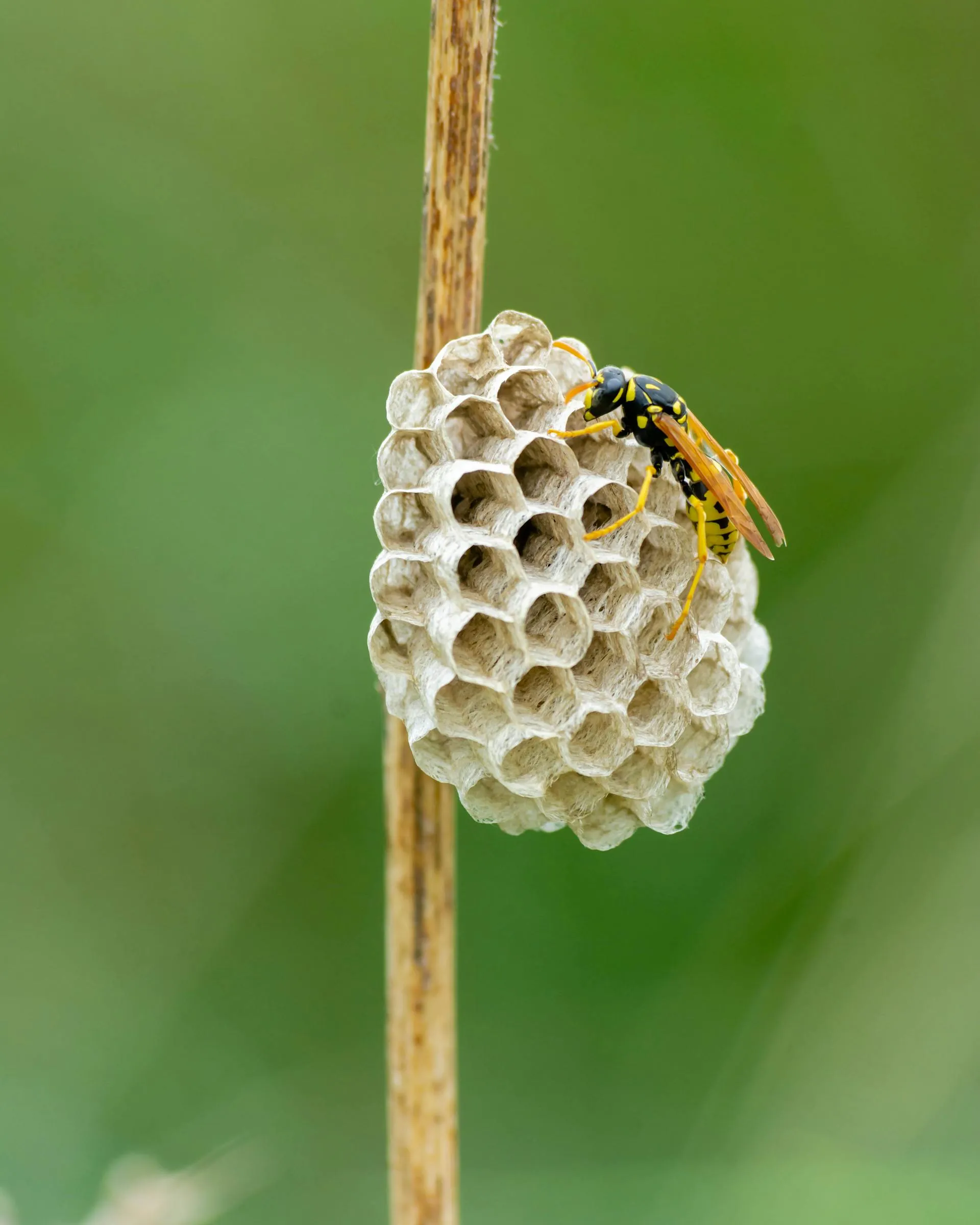
A paper wasp nest under an Adelaide eave is a small open umbrella of grey-brown hexagonal cells, usually 5-25 cm across, with a handful of slender brown-and-yellow wasps tending the brood. The Adelaide species is almost always Polistes humilis — the Australian paper wasp — a native, mostly non-aggressive insect with a localised sting and a small colony. The European wasp (Vespula germanica) is a different proposition: stockier, brighter yellow, with a hidden nest in a wall cavity, ground hole or compost heap, and a colony that can reach into the tens of thousands. Treatment is similar in principle but the consequences of getting it wrong are very different. Confirming which species you have is step one.
This article covers the identification, the nesting behaviour, when DIY removal is reasonable, when it is not, and the SA-specific reporting position on European wasps.
Identifying Polistes humilis — the Australian paper wasp
Paper wasps in Adelaide are almost always Polistes humilis (sometimes the closely related Polistes variabilis in the same locations). They are easy to identify if you know what you are looking at:
- Slender body, narrow waist. Wasp-shape; not the chunky bee profile.
- Brown and yellow markings — variable, but generally a brown background with yellow bands on the abdomen.
- 15-20 mm long.
- Long legs that dangle in flight — the trailing-leg flight pattern is a reliable visual ID.
- Slow, deliberate flight — not the fast straight-line of a European wasp.
The nest
- Open umbrella shape — visible hexagonal cells, no enclosing envelope.
- Attached by a single stalk to a substrate above (eave, beam, branch, fence post).
- Diameter typically 5-25 cm at full size in late summer.
- Visible to the naked eye at a glance — you do not need to look for this nest, you can see it.
- A small workforce — usually 5-30 adult wasps tending the brood, even at peak.
The nest is built by a single foundress queen in spring; the colony grows through summer; the colony naturally dies off through autumn and winter, leaving the nest abandoned and weathered. New colonies start in new locations the following spring.
Identifying Vespula germanica — the European wasp
The European wasp is a different family, a different colony scale, and a different risk profile. The Australian Museum and PIRSA Biosecurity SA both treat it as a species worth specific identification.
- Stockier body than paper wasps — more “wasp shape” than “wasp silhouette”.
- Bright yellow and black — strongly contrasting bands, less brown, no mistaking the colour pattern.
- 12-17 mm long — slightly smaller than a paper wasp but more solid.
- Legs tucked in flight — not dangling, fast, straight-line flight.
- Unmistakable pattern of black dots down the centre of the yellow abdomen.
The nest
- Enclosed grey paper envelope — completely covers the brood; no visible cells from outside.
- Hidden location — wall cavity, ground hole, compost heap, retaining wall void, gap under a deck. Not visible on an eave.
- Massive colony scale — established nests can hold 10,000-100,000 wasps. The European wasp colony in Australia, where winters are mild enough that nests can persist, can be far larger than the European source population’s seasonal nests.
- Multiple workers entering and leaving a single point — that single point in the wall, ground or cavity is the only outward sign.
A wasp with bright contrasting yellow and black, flying straight and fast, repeatedly entering a single hole in the ground or a wall cavity, is European. Treat it differently.
Quick comparison
| Feature | Paper wasp (Polistes humilis) | European wasp (Vespula germanica) |
|---|---|---|
| Body | Slender, narrow waist, brown-and-yellow | Stocky, bright yellow-and-black |
| Flight | Slow, dangling legs | Fast, legs tucked, straight-line |
| Nest | Open umbrella, visible cells, eaves | Enclosed envelope, hidden cavity |
| Colony size | 5-30 at peak | 10,000-100,000+ |
| Sting risk | Localised, single sting most encounters | Multiple stings common, allergic risk elevated |
| Adelaide range | Across metro grid, common | Established in some Adelaide suburbs, reportable |
European wasp in SA is a species PIRSA Biosecurity tracks; suspected nests can be reported to PIRSA. They are widespread in Victoria and Tasmania and established in some Adelaide locations, particularly the Hills and southern suburbs.
Why paper wasps cluster on Adelaide eaves
Three drivers make Adelaide eaves a paper wasp magnet through summer:
- North-facing eaves get morning sun. The microclimate matches the wasp’s preference — warm, sheltered, dry.
- Water-source proximity. Paper wasps need water for chewing the wood pulp that forms the nest paper. A bird bath, leaky tap, or pool nearby supports nest construction.
- Undisturbed building corners. Eaves are not patrolled or swept the way garden surfaces are. The nest gets to mid-summer scale before the homeowner notices.
Activity peaks December to March — that is when the nest is largest, the workforce most active, and sting incidents most common.
For the wider seasonal context — paper wasps as part of Adelaide’s summer pest pressure alongside cockroaches and ant trails — the Adelaide sugar ants and black house ants guide covers the cluster of summer-driven indoor pressure.
Treatment for a paper wasp nest
A paper wasp nest is one of the few situations where DIY can be reasonable, with caveats. The defence range is short (within 1-2 metres of the nest), the workforce is small, and the chemistry to handle one is widely available.
DIY paper wasp removal — when it is OK
Conditions where DIY can work:
- Accessible nest — under an eave, on a fence post, on a tree branch — that you can reach safely from the ground or a stable single-storey ladder.
- Small to medium nest — under 15 cm diameter, fewer than 20 visible workers.
- No allergic household members.
- Time of day matched to wasp activity — dusk or after dark is the safe treatment window. All workers are at the nest, foraging activity is zero, the colony is least defensive.
Method:
- Wait for dusk. Foraging stops; defence is at its lowest.
- Wear long sleeves, long pants, gloves, eye protection. A torch with a red filter (red light disturbs wasps less than white).
- Use a registered wasp jet aerosol — long-distance spray, allows treatment from 3-4 metres away.
- Direct the jet at the nest stalk and along the visible cells. Saturate the nest paper. Continue for 5-10 seconds.
- Step back. Wait 24 hours.
- Knock the nest down with a long pole the following day. Bin the nest in a sealed bag.
If at any point the workforce becomes active and aggressive, retreat. Do not stand under a nest you have agitated.
When to call a licensed technician
DIY is not reasonable for:
- Above-second-floor nests — height work is the hazard.
- Inside a wall cavity — entry-point treatment, not surface spray, is required.
- Multi-nest scenarios — three or more nests on the same building.
- Paper wasps over an entry door — the nest defends the door; everyone using the door is at risk.
- Allergic household member — the cost of a sting incident is too high.
- Inability to confirm species — if you can’t tell whether it is paper or European, treat it as European until confirmed.
A licensed technician can also use chemistry classes not in retail — an insecticidal dust to the nest interior, applied through a long pole or bee-suit access, that delivers a fast, complete kill with less aerosol exposure for the operator and the household.
European wasp treatment is different
European wasp nests should not be DIY-treated. Two reasons:
- Colony scale. A retail aerosol does not reach the colony in a 30,000-strong enclosed nest. The few wasps you irritate at the entry are the smallest fraction of the workforce.
- Defence response. European wasps recruit aggressively. A disturbed colony produces hundreds of defending workers within seconds. Multiple stings are common.
A licensed European wasp treatment in Adelaide:
- Locate the entry. The nest itself is hidden — the technician identifies the cavity, ground hole, retaining wall, compost heap or under-deck void from foraging activity.
- Inject treatment into the nest. APVMA-registered insecticidal dust pumped through the entry into the nest envelope. Reaches the entire colony, not just the entry traffic.
- Seal post-treatment. Once activity ceases (24-48 hours), the entry is sealed permanently to prevent reuse.
- Bee suit and respirator — non-negotiable PPE. The work is done at dusk for the same reason as paper wasp work: lowest activity.
- Reporting if appropriate. Suspected European wasp nests in SA can be reported to PIRSA Biosecurity SA — the species is monitored at state level.
Sting and allergy reality
Paper wasp sting:
- Localised pain at the site, lasting 1-3 hours.
- Local redness and swelling, resolving within 24-48 hours.
- Itching during the resolution phase.
- Anaphylaxis risk is present in sensitised individuals but lower in incidence than European wasp or Myrmecia (bull ant) reactions.
European wasp sting:
- More aggressive than the paper wasp — single-incident stings tend to be multiple stings rather than singular.
- Same local reaction pattern but at higher dose.
- Significantly higher allergic and anaphylaxis risk. The European wasp is responsible for most wasp-sting medical events in Australia.
- ASCIA-recommended action for known allergic individuals: EpiPen on hand, action plan, allergist consultation.
For the related Myrmecia anaphylaxis context, see the Adelaide bull ants guide — both species share the “treat the nest before someone gets stung” logic.
When to call an emergency removal
- Paper wasp nest above a doorway, walkway, or play area within 24 hours of identification.
- European wasp nest, regardless of location — same-day if possible.
- Allergic household member with a confirmed nest on the property.
- Multiple stings already incurred by anyone in the household — the colony has tipped from passive to defensive and the situation is now active.
- Nest accessed by children — climbing frames, treehouses, deck areas where children play.
For pricing context, paper wasp removal in Adelaide typically sits in the lower part of the pest control cost guide range; European wasp removal is higher because of the equipment and the time involved.
FAQ
How do I get rid of a paper wasp nest in my Adelaide eaves? For an accessible single nest under 15 cm with no allergic household members, a registered wasp jet aerosol applied at dusk from 3-4 metres away will saturate the nest. Wait 24 hours, then remove the nest with a long pole and bin it in a sealed bag. For high nests, multi-nest scenarios, allergic household members, or suspected European wasps, a licensed technician is the right call.
Are paper wasps the same as European wasps? No. Paper wasps (Polistes humilis) are slender, brown-and-yellow, with open umbrella nests under eaves and small colonies of 5-30. European wasps (Vespula germanica) are stockier, bright yellow-and-black, with hidden enclosed nests in wall cavities, ground holes or compost heaps and colonies of 10,000-100,000. The treatment principles overlap; the equipment, the cost and the risk profile do not.
What does a paper wasp nest look like in Adelaide? Open hexagonal cells in a small umbrella shape, attached by a single stalk to an eave, beam, fence post or branch. Grey-brown paper texture. 5-25 cm diameter at peak. A handful of brown-and-yellow slender wasps tending the cells. Nest is visible at a glance — not enclosed, not hidden.
How much does wasp nest removal cost in Adelaide? Paper wasp removal typically sits at the lower end of the Adelaide pest pricing range — single-nest, accessible work. European wasp removal is higher because of the cavity-injection equipment, the bee suit, and the longer service window. The pest control cost guide covers the typical bands; multi-nest jobs, height work and confirmed European wasp work all push pricing up.
Will the wasps come back to the same spot in Adelaide? Paper wasp nests are abandoned each autumn — the colony dies off naturally and the nest is not reused. New colonies the following spring tend to choose new locations, though the same eave structure (north-facing, sheltered, near water) often supports a fresh nest year after year. European wasp nests, in Australia’s mild winters, can persist multiple years and grow into very large colonies — the entry point should be sealed permanently after treatment.
Sources
- Australian Museum — Paper Wasps (Polistes humilis) species page: https://australian.museum/learn/animals/insects/paper-wasps/
- PIRSA Biosecurity SA — European Wasp: https://pir.sa.gov.au/biosecurity/insects/european_wasp
- Australian Museum — European Wasp (Vespula germanica) species page: https://australian.museum/learn/animals/insects/european-wasp/