Pest Fox · Adelaide pest & termite specialists
Summer Pest Control Adelaide — December to March Surge | Pest Fox
By Pest Fox · Published 5 May 2026
Summer Pest Pressure in Adelaide: Why December to March Brings the Surge
Adelaide pest pressure peaks December to March. The hot, dry Mediterranean summer drives cockroaches indoors looking for water, peaks paper wasp and European wasp colonies at their largest size, establishes sugar-ant trails into kitchens, triggers post-rainfall termite swarms, and pushes redback and white-tail spider activity into garden sheds and outdoor furniture. A pre-summer treatment in October or November flattens the curve. By the time you’re swatting wasps and finding cockroaches in the laundry on a 38°C day, you’re treating the symptom — pre-summer is when the work pays.
This guide explains why Adelaide’s specific climate produces this specific pressure profile, what each pest is doing across the four hottest months, and what to do right now (this week, this month, before next summer) to stay in front of it.
The seasonal calendar at a glance
| Pest | Peak window | What you’ll see | Treatment cadence |
|---|---|---|---|
| German cockroach | Dec–Mar (year-round indoors) | Kitchen activity, especially near water | Pre-summer + monitoring |
| Coastal brown cockroach | Nov–Apr | Veranda, garage, outdoor kitchen | Pre-summer perimeter |
| Paper wasp | Dec–Mar (colony peak) | Eaves, pergola, outdoor dining | As-found callout |
| European wasp | Jan–Apr (colony peak) | Ground nests, wall cavities | Same-day callout |
| Sugar ant | Nov–Mar | Internal trails into kitchen | Pre-summer + targeted bait |
| Black house ant | Oct–Apr | Internal trails, kitchen and bathroom | Pre-summer + targeted bait |
| Argentine ant | Year-round, Dec–Feb peak | Outdoor swarm into all openings | Quarterly program |
| Coptotermes alates (swarmers) | Oct–Dec post-rain | Winged termites at lights | Inspection on sighting |
| Redback spider | Nov–Apr | Garden shed, outdoor furniture, retaining wall | Pre-summer external |
| White-tail spider | Nov–Apr | Internal harbourage (wardrobes, beds) | Pre-summer internal |
| Huntsman spider | Dec–Apr | Internal walls, ceilings | Perception management; rarely treated |
Pre-summer treatment in October–November addresses the foundational pressure — cockroach harbourage, ant trail establishment, spider harbourage — before colonies reach summer peak. By December, you are reacting to colonies that established four to eight weeks earlier; by February, you are paying for emergency callouts on wasp nests at full strength.
The Adelaide summer climate and pest biology
Adelaide is on the southern edge of the Mediterranean climate zone — dry hot summers, cool wet winters, low average summer humidity, occasional 40°C+ heat events. The Bureau of Meteorology long-term records for Adelaide (Kent Town and West Terrace stations) show:
- December mean maximum — approximately 27–28°C
- January mean maximum — approximately 29–32°C, the hottest month
- February mean maximum — approximately 29–31°C
- March mean maximum — approximately 26–28°C, transition month
- Summer rainfall — among the lowest in Australian capital cities; the wet season is May to October, not November to April
- Heatwaves — multi-day events above 35°C are routine; events above 40°C occur most summers
What this climate does to pest biology:
- Cockroach water-seeking. German and American cockroach populations cannot survive extended dry exposure. Hot dry exterior conditions push the colony toward indoor moisture sources — kitchens, laundries, bathrooms, leaking dishwasher bases. The summer kitchen presence is the colony moving in from less-favourable harbourage outside.
- Wasp colony cycle. Paper wasp and European wasp colonies expand from a single overwintering queen through spring and reach maximum population by mid-to-late summer. The eaves nest you noticed in December at fifty workers is a 200-worker nest by February.
- Ant trail activity. Sugar ant and black house ant colonies forage more aggressively in summer because brood-rearing demand peaks. A trail into the kitchen is workers transporting carbohydrate back to a nest typically located in soil, mulch, or wall voids.
- Termite alate flights. Coptotermes acinaciformis — the dominant Adelaide termite — flies its annual reproductive flight after warm-evening rainfall events, typically October to December (late spring) extending into early summer. Alates at the porch light are the colony signalling reproductive maturity nearby.
- Spider activity peaks. Redback (Latrodectus hasselti) and white-tail (Lampona) populations peak through summer; redback is the public-health concern, white-tail the household-anxiety case.
The single climate variable that does the most damage is dry-summer water-seeking — it converts an outdoor cockroach population into an indoor one.
The cockroach surge
Two species, two profiles.
German cockroach (Blattella germanica) — small (10–15 mm), light tan, two parallel dark stripes on the pronotum. Lives indoors year-round but visibility peaks in summer because populations expand under warm conditions. Kitchen-dominant. Bug bombs and surface sprays make this colony worse — see the German cockroach treatment guide for what actually works.
Coastal brown cockroach (Periplaneta australasiae) — large (30–35 mm), reddish-brown, yellow shoulder margin. Lives outdoors and edges into the property in summer through weep-holes, slab cracks, and verandah edges. Less intrinsically a pest than German cockroach, but the size and visibility produce the calls.
What pre-summer cockroach treatment looks like:
- External perimeter treatment with APVMA-registered residual chemistry to weep-holes, slab edges, garage corners, and outbuilding bases
- Internal harbourage gel baiting in known kitchen, laundry and bathroom harbourage zones
- Roof-void and subfloor inspection to confirm no cockroach harbourage in cavity spaces
- Sanitation review — water-source identification (leaking dishwasher base, condensation under fridge, damp under-sink area), food-storage review
Pre-summer (October–November) catches the colony before it has expanded; mid-summer (January–February) is reactive. The cost is the same; the result is better.
Paper wasp and European wasp peak
Adelaide carries both species. They are not the same pest.
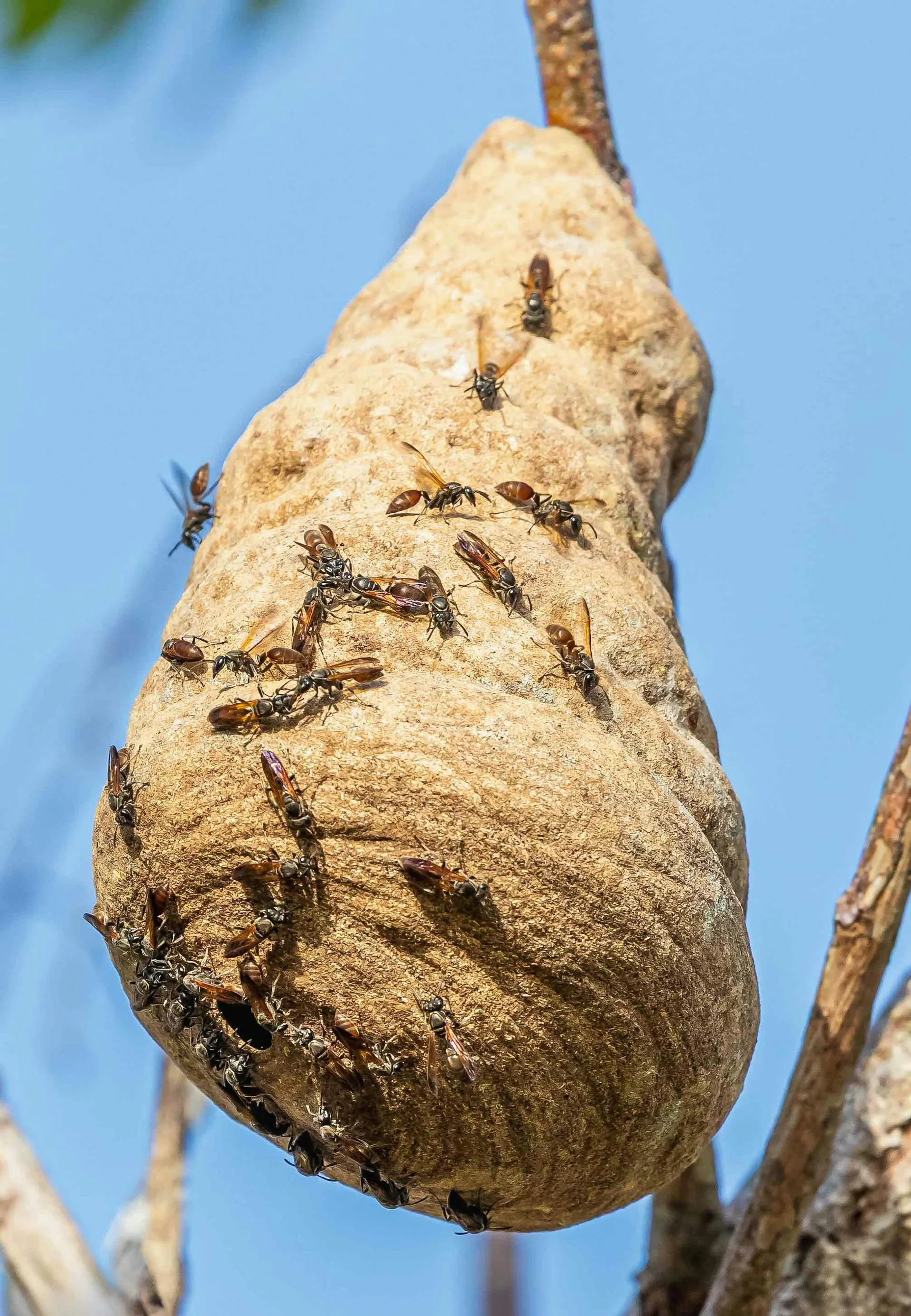
Paper wasp (Polistes humilis and P. variabilis) — slender, reddish-brown, builds an exposed open-celled paper nest on a single attachment point under eaves, on pergolas, in rafters and on outdoor furniture undersides. Nest size at peak is typically 50–200 workers. Sting is painful but not generally life-threatening unless the household has wasp-venom allergy.
European wasp (Vespula germanica) — yellow and black, builds a concealed nest in ground cavities, wall voids, roof voids, retaining wall gaps, and tree hollows. Nest size at peak can exceed 5,000 workers. Aggressive when disturbed; sting is dangerous to allergic individuals and to children. Established in parts of Adelaide and monitored by PIRSA Biosecurity SA — suspected nests can be reported. Same-day removal is the standard response.
The colony cycle for both species:
- Spring — overwintering queens emerge, found new nests (single queen, single nest)
- Summer — workers expand the colony exponentially
- Late summer (peak) — colony at maximum size, foraging pressure highest, sting incidents peak
- Autumn — colony declines, new queens disperse to overwinter
- Winter — colony dies, queens overwinter in protected cavities
What pre-summer wasp treatment looks like:
- Eave and rafter inspection — paper wasp nest sites identified and treated before colony expansion
- Cavity audit — known European wasp ground-nest sites (retaining wall gaps, fence post bases, tree stumps) inspected
- Treatment of identified nests — APVMA-registered dust formulation applied directly to the nest entrance; nest dies inside 24–48 hours
Detail on the paper wasp removal article — paper wasp is the standard summer call, European wasp the urgent one.
Sugar ant and black house ant trails
Two species, similar treatment, different appearance.
Sugar ant (Camponotus consobrinus) — large (5–15 mm), banded brown and orange, slow-trailing, single-nest colony. Active at night in summer; trails into kitchens after sweet residue.
Black house ant (Ochetellus glaber) — small (2.5–3 mm), shiny black, fast-trailing, multi-nest colony. Active day and night through summer; trails into kitchens and bathrooms.
The summer trail dynamic:
- Soil-dwelling colony moves into wall cavities, slab cracks and weep-holes after summer rainfall events
- Foragers establish a pheromone trail to indoor food sources
- Trail thickens as the colony’s brood demand grows
- Trail moves when the food source moves — clean the bench, the trail relocates to the next attractant
What works:
- Targeted gel bait to the trail — workers carry the bait back to the nest; colony eliminated over 3–7 days
- Avoid surface-spray on the trail — knocks down workers but doesn’t reach the colony; trail re-establishes inside 48 hours
- External perimeter treatment with APVMA-registered residual chemistry through weep-holes and slab edges
- Sanitation — sweet-residue cleanup, food storage in sealed containers, pet-bowl cleanup
The sugar ants and black house ants article covers the species-specific treatment in detail. Pre-summer is the right window — by January, the trail is established and treatment is reactive.
Termite alate (swarmer) flight
Adelaide Coptotermes acinaciformis swarms its annual reproductive flight in late spring and early summer — typically October to December, extending into January in some seasons. Flights occur after warm-evening rainfall when humidity is elevated. Alates (winged reproductive termites) emerge in the thousands from mature colonies, fly briefly, drop their wings, pair up, and attempt to found new colonies.
Why this matters in summer pest planning:
- Alates at your porch light, kitchen window, or pool light indicate a mature colony within 50–100 metres — possibly in your structure, possibly in a neighbour’s, possibly in a stump or street tree (if you’re inheriting a property with an old pool surround that may include landscaping debris and stumps, see pool builders and spa installers in Adelaide for the renovation lane)
- A mature colony does not appear from nowhere — it has been growing for 3–5 years before reaching reproductive maturity
- Alate sighting warrants an immediate inspection — not next month, this week
The dedicated spring termite swarm article covers identification (alate vs flying ant), what to do in the first 48 hours after a sighting, and how this connects to the broader termite inspection regime.
Spider activity in Adelaide summer
Three species drive Adelaide summer spider calls.
Redback (Latrodectus hasselti) — small (~10 mm female), black with red dorsal stripe, builds a tangled web in dark protected outdoor cavities. Garden sheds, outdoor furniture undersides, retaining wall voids, brick crevices, woodpiles. Sting is medically significant; antivenom is held by SA hospitals. Children, pets and outdoor furniture interaction drive the calls.
White-tail (Lampona cylindrata, L. murina) — medium (~12–15 mm), grey-black with characteristic white spot at the abdomen tip, internal harbourage. Wardrobes, bedding, bathroom corners. Bite causes localised reaction; the necrotic-bite reputation is not supported by current Australian peer-reviewed literature (Isbister 2003). Calls driven by bite anxiety and household discovery.
Huntsman (Holconia, Heteropoda) — large (legspan to 15 cm), hairy, fast on a flat surface, otherwise harmless. Indoor walls and ceilings. Calls driven entirely by perception; treatment is rarely warranted on entomological grounds.
What pre-summer spider treatment looks like:
- External harbourage treatment — APVMA-registered residual chemistry to redback harbourage zones (sheds, outdoor furniture undersides, retaining walls)
- Internal harbourage treatment — corner-and-skirting treatment for white-tail in bedrooms and bathrooms
- Web-knock and inspection — accessible eaves, garage corners, shed ceilings
Spider treatment is usually bundled into a general pest treatment ($180–$350) rather than priced separately. Standalone spider work runs $180–$320 per visit.
Pre-summer prep checklist — October to November
Right now, this month, this week. The prep work that flattens the December–March pressure curve.
What to do this week (any week in October or November)
- Walk the perimeter. Look for cockroach activity at slab edges, ant trails on paving, redback webs in garden furniture, paper wasp nests starting under eaves, alate evidence (shed wings) on porch lights or near windows.
- Audit fly-screens. Every external door and window screen — fix tears, replace warped corners, seal gaps where the screen meets the frame.
- Check weep-holes. Any visible mud-tube or ant trail at a weep-hole is the first call to action; weep-hole guards (bronze or stainless mesh) are a $50 hardware-store fix that pays.
- Move firewood, compost, and mulch piles at least 5 metres from the slab edge. Cellulose against the wall is termite invitation and rodent harbourage.
- Trim vegetation away from the building so no foliage touches walls, eaves or roof. Touching foliage is an ant highway and a cockroach harbourage.
What to do this month (October or November)
- Book a pre-summer general pest treatment ($180–$350 — see the pest control cost guide). Internal and external scope, harbourage focus, gel baiting where indicated.
- Book a termite inspection if you have not had one in the past 12 months. Standards Australia recommends not more than 12 months between inspections; spring is the high-risk window for alate flight evidence.
- Set quarterly program if your property has bushland adjacency, mature gardens, heritage construction, or year-round multi-pest activity. Quarterly runs $120–$200 per visit ($480–$800 per year) and includes continuous warranty between visits.
What to do before summer (by end of November)
- Audit outdoor furniture for redback webs; treat or wipe-clean before the kids start using the patio
- Review pet bedding and outdoor pet areas — flea pressure rises with summer; treat now, not at end of lease
- Confirm any outdoor structures (cubby house, granny flat, pool pump shed) are inside your treatment scope
- Check insurance — some home insurance policies require pest control records for vermin-related claim eligibility (see the sandstone villa article on why insurance does not cover termite damage but does interact with pest documentation in some claims)
Quarterly programs vs one-shot pre-summer
A pre-summer one-shot ($180–$350) is the minimum sensible scope for an Adelaide property. A quarterly program ($120–$200 per visit, $480–$800 per year) is the right step up for properties with sustained pressure.
The economics:
- One-shot pre-summer + reactive callouts — typically a household pays $250 in October plus 1–2 callouts at $200–$300 each across summer; total $650–$850
- Quarterly program — $600–$800 per year, four visits, continuous warranty, no callout costs for in-warranty pests
The quarterly program is the right fit for:
- Properties with bushland adjacency (foothills, Adelaide Hills, eastern fringe)
- Older homes with conducive conditions (heritage stock, mature gardens, suspended timber floors — the sandstone villa heritage article is the relevant deep-dive)
- Households with allergy or asthma triggers from cockroach/spider exposure
- Body-corporate properties with existing pest clauses
- Homes with persistent ant or rodent pressure season-on-season
A one-shot pre-summer suits properties without sustained pressure where the issue is acute and seasonal — newer homes, simple landscaping, no bushland adjacency.
What changes in 2026 — the APVMA SGAR rule
One thing has shifted between the 2025 summer and the 2026 summer that affects rodent pressure: APVMA has restricted second-generation anticoagulant rodenticides from over-the-counter sale to consumers from 24 March 2026. Licensed pest controllers retain access for commercial use under stricter recordkeeping. The full regulatory context sits in the dedicated APVMA 2026 rules article (published in the existing pillar set).
For summer pest planning, the practical message is: rodent pressure is now a licensed-operator problem, not a Bunnings-aisle problem. If you are seeing rat or mouse activity in summer (less common than winter, but real around bin areas, compost bins and outdoor pet feeding zones), the supermarket fix is gone. Book a treatment.
FAQ
When should I get pest control done before summer in Adelaide? October or November is the right window. Pre-summer treatment catches harbourage and trail establishment before colonies reach mid-summer peak. By December, the colony has expanded; by February, you are paying for reactive callouts. The cost is similar; the result is better. Book six to eight weeks before the first 35°C+ heatwave, which is typically late November or early December in Adelaide.
Why are there more cockroaches in summer? Adelaide’s hot dry summer climate dehydrates exterior cockroach populations and pushes them indoors toward kitchen, laundry and bathroom water sources. The summer kitchen presence is largely an outdoor population relocating, not a new colony establishing. Pre-summer external perimeter treatment combined with internal harbourage gel baiting catches the population before relocation.
Do termites swarm in Adelaide summer? Adelaide Coptotermes acinaciformis alates fly their annual reproductive flight in late spring and early summer — typically October to December, sometimes extending into January. Flights occur after warm-evening rainfall when humidity is elevated. Alates at your porch light or pool light indicate a mature colony within 50–100 metres and warrant immediate inspection — not next month, this week. The spring termite swarm article covers the identification and response in detail.
Should I get a quarterly pest program? A quarterly program suits properties with bushland adjacency, heritage construction, mature gardens, or persistent pest pressure. The cost is $480–$800 per year for four visits with continuous warranty between visits. A one-shot pre-summer treatment ($180–$350) suits simpler properties without sustained pressure. The economic break-even is two reactive callouts per summer — if your property typically sees more than that, the quarterly program saves money as well as time.
What pests peak in Adelaide summer? Cockroach activity (German and coastal brown), paper wasp and European wasp colonies at maximum size, sugar ant and black house ant trails into kitchens, Coptotermes termite alate flights (October–December), redback and white-tail spider activity, and Argentine ant outdoor swarms. The single highest-callout pest is paper wasp under eaves; the single most dangerous is European wasp at peak colony size.
Can I treat summer pests myself? For some pests, partly. Paper wasp nests at ground level can be treated with retail products if the nest is small and the household has no allergy concerns; European wasp nests should never be treated by a household — colony size and aggression make this dangerous. Cockroach surface spray and bug bombs make German cockroach colonies worse (insecticide-induced dispersal). Ant trail surface spray knocks down workers but does not reach the colony; gel bait is the right approach. Spider treatment for redback specifically warrants licensed application. Pre-summer professional treatment usually costs less than the cumulative DIY-then-reactive-callout pathway.
Sources
- Bureau of Meteorology — Adelaide climate averages (Kent Town and West Terrace stations): http://www.bom.gov.au/climate/averages/tables/cw_023034.shtml
- AEPMA — Australian Environmental Pest Managers Association: https://aepma.com.au/
- Australian Pesticides and Veterinary Medicines Authority (APVMA): https://www.apvma.gov.au/
- CSIRO — Australian termite swarm phenology and Coptotermes biology: https://www.csiro.au/
- Isbister GK, Gray MR (2003). White-tail spider bite: a prospective study of 130 definite bites. Medical Journal of Australia.